{% if video-embed-url != blank %} {% endif %}

Best Compensation Planning Software in 2026

June 9, 2026

Compensation planning software helps organizations plan salary increases, merit cycles, bonuses, equity awards, pay ranges, and pay equity analysis, replacing disconnected spreadsheets with structured, data-driven compensation decisions. Most platforms are evaluated on three core workflows: salary planning, bonus and incentive management, and compliance tracking. The question in 2026 is no longer whether to use dedicated software, but which platform fits your organization's specific compensation model.

The market segments into four distinct lanes: benchmarking-first platforms that specialize in market data and pay intelligence; cycle-execution platforms built to run merit cycles, approval workflows, and budget allocations end-to-end; sales compensation and SPM specialists focused on commissions, quotas, and variable pay; and all-in-one HCM suites that include compensation as one module within a broader people system. Choosing the wrong lane is the most common and costly mistake buyers make. Buying a benchmarking platform when you need cycle execution, or a sales commission platform when you need total rewards management, leads to wrong-fit purchases that require replacement within 18 months.

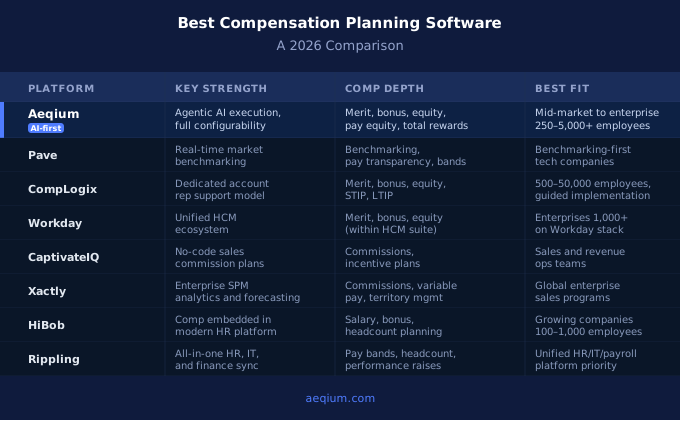
This comparison covers eight platforms that consistently appear on mid-market and enterprise shortlists: Aeqium, Pave, CompLogix, Workday, CaptivateIQ, Xactly, HiBob, and Rippling. Each profile addresses core strengths, compensation depth, support model, and the buyer profile it actually fits.

Platform Key Strength Compensation Depth Support Model Best Fit
Aeqium AI-driven execution, full configurability, fast implementation Merit, bonus, equity, offers, pay equity monitoring, total rewards, salary bands Self-service + dedicated customer success; SOC 2 Type 2 Growing mid-market and enterprise teams replacing spreadsheets or rigid HRIS modules
Pave Real-time market benchmarking via live HRIS integrations Benchmarking, pay transparency, salary bands Self-service + responsive support Organizations where accurate, current market data drives hiring and pay decisions
CompLogix Configurable planning with dedicated account support Merit, bonus, equity, STIP, LTIP, promotions, total rewards statements Dedicated account representative Mid-market to enterprise needing guided implementation and a named support partner
Workday Unified HCM ecosystem with native data flows Merit, bonus, equity, workforce planning (within HCM suite — not standalone) IT-supported; training required; ticket-based escalation Enterprises (1,000+ employees) already standardized on the Workday stack
CaptivateIQ Sales commission automation with no-code plan building Commissions, incentive plans, payout management, rep earnings visibility Self-service + platform support Sales and revenue ops teams managing complex commission structures
Xactly Enterprise SPM analytics, forecasting, and territory management Commissions, bonuses, variable pay, territory and quota management Enterprise support tiers Global enterprises with high-volume, complex sales compensation programs
HiBob Modern HR platform with integrated compensation module Salary, bonus, headcount planning, some equity Platform support Growing companies wanting compensation embedded in a modern HR platform
Rippling All-in-one HR, IT, and finance sync with payroll integration Pay bands, headcount planning, performance-linked raises, equity alerts Platform support Organizations prioritizing a unified HR, payroll, and finance platform over comp-specific depth
Key takeaway: Choose Aeqium or CompLogix for fast, configurable cycle execution. Choose Pave for best-in-class market benchmarking. Choose CaptivateIQ or Xactly when sales commissions are the primary use case. Choose Workday, HiBob, or Rippling when a unified HCM or all-in-one platform is the overriding priority.

What Separates Good Compensation Planning Software from Adequate?

Before evaluating any platform, establish the criteria that matter for your specific compensation workflow. Five dimensions determine fit across every platform in this comparison.

1. Benchmarking vs. execution. Compensation benchmarking compares your pay levels against market data to ensure competitiveness. Compensation execution is the workflow of running merit cycles, allocating budgets, routing approvals, and generating total rewards statements. Some platforms do one well; few do both. Clarify which is your primary need before requesting demos.

2. Scale and governance. Mid-market organizations typically need speed, configurability, and self-service administration. Enterprise organizations add requirements for auditability, multi-country pay structures, and centralized governance across business units. The platforms optimized for each profile are different.

3. Sales compensation specialization. If commissions, quotas, and variable pay are the core use case, a Sales Performance Management platform (not a general compensation planner) is the right category. CaptivateIQ and Xactly exist in this lane. Conflating SPM with total rewards planning leads to wrong-fit purchases.

4. Speed of implementation and configurability. How quickly can the platform be operational? Can a compensation team configure plan logic, approval chains, and eligibility rules without engineering support? For lean HR teams running tight cycle windows, time-to-value and self-service configuration are non-negotiable.

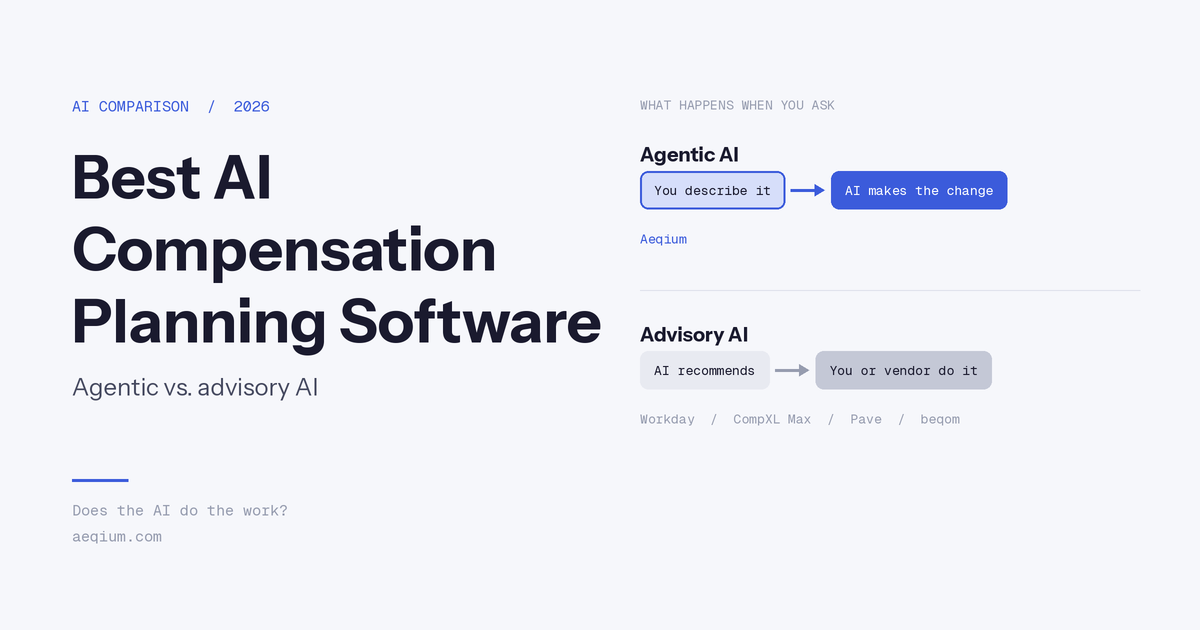
5. AI execution vs. AI advisory. Distinguish between AI that executes tasks end-to-end and AI that surfaces data and leaves the work to you. These are fundamentally different capabilities with fundamentally different impacts on how much time your team spends on the process.

Platform Profiles

1. Aeqium: Best for AI-Driven, Configurable Compensation Execution

Key Strength: Agentic AI that executes compensation work end-to-end, combined with Excel-level configurabilityComp Depth: Merit, bonus, equity, offers, pay equity monitoring, total rewards, salary bandsSupport Model: Self-service + dedicated customer success; SOC 2 Type 2 certified, GDPR compliantBest Fit: Mid-market and enterprise total rewards teams (250–5,000+ employees) replacing spreadsheets or rigid HRIS modules, particularly those with complex incentive structures

Aeqium is the only fully flexible AI compensation planning platform that executes any level of compensation complexity (merit cycles, offer workflows, pay equity monitoring, salary bands) without coding or external assistance. The platform's design principle is that the AI absorbs complexity so the platform remains easy to use regardless of how nuanced the underlying compensation program is. Aeqium integrates natively with BambooHR, Workday, Rippling, ADP Workforce Now, SAP, Xero, and TriNet HR Plus.

AI-driven execution, not just advice. Aeqium AI configures compensation cycles, builds logic, manages bands, and surfaces analytics in plain language. Administrators describe what they need; the system executes it (including budget allocation, approval chain setup, proration logic, and merit matrix construction) without IT involvement. This is categorically different from AI that generates a recommendation and hands the work back to you.

Full configurability without code. Teams configure their own data sources, review chains, custom calculations, and budget distribution methods. The platform adapts to your compensation philosophy rather than requiring you to simplify your program to match the platform's structure.

"Other platforms want to fit you into a box and say, 'this is how you should be doing it.' But with Aeqium, we were in the driver's seat and could tell the platform how we wanted things to look." — Carter Faison, Head of Total Rewards, Thoropass

Year-round compensation data management. Aeqium handles salary band management, compa-ratio tracking, pay equity monitoring, and continuous analytics outside of cycle windows. Every comp decision generates a complete audit trail automatically.

Manager experience that reduces HR overhead. Managers receive real-time total rewards visibility and built-in context for every planning decision.

"Our managers estimate they complete their reviews in half the time and there are 90% fewer errors in the data." — Danada Hart, Global Compensation Manager, Braze

Fast implementation. Technical implementation takes a few hours. Full onboarding (including pay band uploads, user training, and cycle setup) averages four to six weeks.

What it doesn't do: Aeqium does not provide proprietary compensation benchmarking data. Teams that need market pricing integrated into their compensation decisions will connect an external benchmarking source. Aeqium's integration ecosystem accommodates this, but it is an additional setup step.

2. Pave: Best for Benchmarking-First Organizations

Key Strength: Real-time market benchmarking aggregated from live HRIS integrationsComp Depth: Benchmarking, pay transparency, salary bandsSupport Model: Self-service + responsive supportBest Fit: Technology companies and growth-stage organizations (100–2,000 employees) where current market data is the primary driver of pay decisions

Pave is a compensation intelligence platform whose core differentiator is real-time market data. Rather than relying on annual survey submissions, Pave aggregates compensation data from thousands of companies through live HRIS integrations. This gives total rewards teams access to current pay intelligence rather than data that is six to twelve months stale by the time it reaches them.

Pave's benchmarking data is more current than traditional survey providers because it draws from live HRIS integrations rather than point-in-time survey submissions. The interface for building and visualizing pay ranges is clean and accessible for teams without deep compensation analytics experience. Pay transparency and total rewards communication features help teams share compensation context with employees and candidates.

What it doesn't do: Pave is more advisory than execution-focused for compensation cycles. Teams that need to run end-to-end merit cycles, configure complex approval workflows, multi-factor bonus logic, or STIP and LTIP programs will find Pave's cycle administration depth lighter than dedicated execution platforms. Market data coverage is strongest for technology roles; organizations with significant non-tech workforces should validate coverage depth before committing.

3. CompLogix: Best for Guided Implementation with Dedicated Support

Key Strength: Full compensation program depth with a dedicated account representative modelComp Depth: Merit, bonus, equity, STIP, LTIP, promotions, total rewards statementsSupport Model: Dedicated account representative for every clientBest Fit: Mid-market to enterprise organizations (500–50,000+ employees) that want a configurable system with guided, vendor-supported implementation

CompLogix has been in compensation management since 1998, making it one of the most tenured vendors in the category. The platform handles the full compensation program lifecycle and is designed for organizations that want a configurable system delivered through a guided, vendor-supported implementation. CompLogix holds 4.9 stars across G2, Capterra, and GetApp based on 123+ reviews.

CompLogix supports the widest range of compensation program types in the mid-market: merit cycles, short-term incentive plans, long-term incentive plans, equity, and promotion planning within a single platform. The dedicated account representative model means that when something needs adjustment mid-cycle, the contact who answers knows the client's specific configuration. This support model consistently appears as a key differentiator in customer reviews.

What it doesn't do: CompLogix does not include proprietary benchmarking data, so external market data sources are required for pay range development. The guided, vendor-led model that is a strength for some organizations may feel slower for teams that want to configure and adjust their own programs without scheduling vendor involvement. Organizations prioritizing AI-driven self-service workflows will find Aeqium a closer fit.

4. Workday Compensation: Best for Enterprises Already on the Workday Stack

Key Strength: Native integration within the Workday HCM ecosystemComp Depth: Merit, bonus, equity, workforce planning (as part of the HCM suite; not a standalone platform)Support Model: IT-supported; training required; ticket-based escalationBest Fit: Large enterprises (1,000+ employees) already committed to the full Workday HCM stack

Workday Compensation is not a standalone compensation platform. It is a module within the Workday HCM suite. Its primary value proposition is native integration with the broader Workday ecosystem: workforce planning, payroll, talent, and finance data flow through a single data model without external connectors to maintain. Outside the Workday-everything context, it is difficult to recommend.

The unified data model eliminates integration maintenance between compensation and payroll, talent, and headcount planning. Governance and auditability are strong within the existing Workday audit framework. For global enterprises managing compensation across multiple countries and business units, Workday's centralized architecture supports the oversight large organizations require.

What it doesn't do: Configuration changes outside standard plan design often require a Workday developer, adding cost and slowing anything time-sensitive. The UI draws consistent criticism for requiring too many steps on tasks that should be straightforward. Implementation timelines and total cost of ownership are significantly higher than dedicated compensation platforms. Compensation professionals who have used both Workday and a dedicated platform consistently report comparable value with meaningfully more complexity.

5. CaptivateIQ: Best for Sales Commission Management

Key Strength: No-code sales commission plan building with real-time rep earnings visibilityComp Depth: Commissions, incentive plans, payout management, rep earnings visibilitySupport Model: Self-service + platform supportBest Fit: Revenue and sales operations teams managing complex, frequently changing commission structures

CaptivateIQ is a Sales Performance Management platform built specifically for complex sales compensation and incentive plan management. It is not a general-purpose compensation planning platform. Its SmartGrid engine allows compensation and sales operations administrators to build and modify commission plans without engineering support. This is a meaningful capability given how frequently sales plans change during the fiscal year.

CaptivateIQ's SmartGrid engine gives non-technical administrators the ability to build and adjust sales compensation plan logic without involving engineering. Sales representatives can see their real-time earnings as deals close, reducing disputes and improving rep motivation. The platform handles plan modeling alongside commission calculation and payout management.

What it doesn't do: CaptivateIQ does not handle merit increases, salary band management, equity administration, pay equity monitoring, or total rewards communication for the broader employee population. Organizations that need SPM and broader compensation planning should evaluate CaptivateIQ alongside a separate total rewards platform.

6. Xactly: Best for Enterprise Sales Compensation at Scale

Key Strength: Enterprise-grade SPM analytics, territory management, and finance-grade forecastingComp Depth: Commissions, bonuses, variable pay, territory and quota managementSupport Model: Enterprise support tiersBest Fit: Global enterprises with high-volume sales compensation programs requiring deep analytics and finance-grade forecasting

Xactly is the enterprise-grade Sales Performance Management platform for organizations with high-volume, global sales compensation programs. Xactly Incent handles commissions, bonuses, and variable pay at scale, and includes commission transparency dashboards and forecasting capabilities for finance teams.

Xactly's forecasting capabilities allow finance teams to model the cost of incentive programs before and during the fiscal year. Commission transparency dashboards give sales representatives a clear view of their earnings. Xactly also supports territory and quota management alongside incentive calculation.

What it doesn't do: Xactly is an enterprise platform with enterprise implementation requirements. It is not designed for organizations that need fast time-to-value or lean self-service administration. Like CaptivateIQ, Xactly is a Sales Performance Management platform and does not replace a total rewards or merit cycle planning system for the broader workforce.

7. HiBob: Best for Growing Companies Wanting Integrated HR and Compensation

Key Strength: Compensation planning embedded within a modern HR platformComp Depth: Salary, bonus, headcount planning, some equitySupport Model: Platform supportBest Fit: Growing companies (100–1,000 employees) that want compensation management embedded in a broader people system and have relatively standard compensation programs

HiBob is a modern HR platform with integrated compensation planning features, built for growing companies that want compensation management embedded within a broader people system rather than managed in a standalone platform. HiBob's strengths are in integrated headcount and compensation planning. It connects pay decisions to the employee record within the same platform used for onboarding, performance, and workforce management.

HiBob's integration of compensation planning within a modern HR platform reduces the number of systems a growing HR team needs to manage. Headcount planning and compensation planning are connected natively, useful for organizations that manage headcount budget and salary budget in the same planning cycle. The platform's modern interface is well-regarded for accessibility and ease of use for HR generalists.

What it doesn't do: HiBob's compensation module is not designed for organizations with complex incentive structures, STIP and LTIP programs, or nuanced merit cycle logic requiring custom configurability. Users report a learning curve for advanced compensation reporting and analytics. Organizations with sophisticated total rewards programs will typically find dedicated compensation platforms offer meaningfully more depth.

8. Rippling: Best for All-in-One HR, IT, and Finance Integration

Key Strength: Compensation changes sync directly into payroll within a unified HR, IT, and finance platformComp Depth: Pay bands, headcount planning, performance-linked raises, equity alertsSupport Model: Platform supportBest Fit: Organizations prioritizing a single platform for HR, IT, payroll, and finance, willing to trade off compensation-specific depth for breadth of integration

Rippling is an all-in-one platform that ties HR, IT, payroll, and finance together. Compensation planning is one module within a unified system, not the core product. Rippling's defining capability in compensation is syncing approved compensation changes directly into payroll, eliminating the manual export-import process that creates errors and delays. Aeqium integrates natively with Rippling, so teams can use both platforms together for cycle execution depth alongside Rippling's payroll and IT integration.

Rippling supports pay bands, headcount planning, and performance-linked raises. The direct connection between approved compensation changes and payroll processing reduces administrative work and the risk of manual errors between HR and finance systems.

What it doesn't do: Complex merit cycle logic, STIP and LTIP modeling, nuanced approval hierarchies, and pay equity workflows are not Rippling's core capability. Organizations with sophisticated compensation programs that also want Rippling's payroll integration should consider pairing Rippling with a dedicated compensation platform like Aeqium, which integrates natively with Rippling.

How to Choose the Right Compensation Planning Software

The biggest mistake buyers make is starting with a feature list instead of clarifying their core workflow. Begin by identifying the primary need: benchmarking, merit-cycle execution, incentive pay, pay equity, or enterprise governance. Then match that need to the platform category built for it.

Decision Framework by Use Case

If your main problem is chaotic, error-prone merit cycles:

You need a cycle-execution platform with configurable approval workflows, budget guardrails, and manager guidance built in. Aeqium or CompLogix.

If your main problem is not knowing whether your pay is competitive:

You need benchmarking before execution. Start with Pave to establish market-anchored pay ranges, then layer in Aeqium for cycle execution if needed.

If your main problem is sales commission accuracy:

You are in a different category entirely. CaptivateIQ for mid-market; Xactly for enterprise-scale sales compensation programs.

If your main problem is pay equity compliance:

You need continuous equity monitoring, not a once-per-year audit. Aeqium runs equity analysis year-round as a standard capability. This is the use case where the difference between dedicated execution platforms and HRIS modules is most pronounced.

If you are already on Workday and need to close the comp planning gap:

Aeqium integrates with Workday and covers the planning depth the Workday module does not. Keep Workday as the system of record; run your compensation cycles in a platform built specifically for that workflow.

If you are an organization of 1,000+ employees fully committed to a single-vendor approach:

Workday if you are already on the stack; HiBob or Rippling if you are building a consolidated HR platform and compensation is a secondary workflow.

Seven Questions to Ask Every Vendor

  1. What is your median time from contract signature to first live cycle for a company our size? Aeqium's technical implementation takes hours; full onboarding averages four to six weeks.
  2. Can we change an approval hierarchy or add a custom proration rule during a live cycle without involving your team or IT? This single question separates truly self-service platforms from vendor-dependent ones.
  3. Who is our named support contact, and what is the escalation path if something breaks during cycle close? The answer to this question matters more during a live cycle than any feature on a comparison chart.
  4. How does your AI work: does it execute tasks or surface recommendations? AI that executes (Aeqium) and AI that advises (most other platforms in this comparison) produce fundamentally different outcomes for lean HR teams.
  5. What HRIS platforms do you integrate with natively, and what does the data sync process look like? Gaps in integration create manual data management that compounds across every cycle.
  6. How do you handle comp programs with multiple incentive types (merit, bonus, equity, STIP, and LTIP) in a single cycle? The answer reveals quickly whether the platform handles complexity natively or requires workarounds.
  7. What does your implementation process look like, and what do we own versus what does your team own? For lean total rewards teams, the distinction between self-service and vendor-managed configuration is an ongoing operational cost, not a one-time setup difference.

Frequently Asked Questions

What is compensation planning software?

Compensation planning software helps organizations plan salary increases, merit cycles, bonuses, equity awards, pay ranges, and pay equity analysis. It replaces manual spreadsheets with structured, automated workflows that support data-driven compensation decisions. Most platforms are evaluated on salary planning, bonus and incentive management, and compliance tracking.

Which platforms are best for merit cycles and salary planning?

Platforms designed for compensation cycle execution, with configurable merit workflows, manager approval routing, budget allocation, and audit trails, are best suited for merit cycles and salary planning. Aeqium and CompLogix are the strongest dedicated execution platforms in this comparison. Workday handles merit cycles within the broader HCM suite for enterprises already on that stack.

How do I decide between a specialized compensation platform and a general HR platform?

If compensation planning involves complex cycles, pay equity monitoring, multi-stakeholder approval workflows, or sophisticated incentive structures, a specialized platform offers meaningfully deeper planning, modeling, and reporting. If compensation is a secondary workflow within a broader HR platform investment, HiBob or Rippling may be sufficient. The decision turns on whether compensation cycle depth or HR platform breadth is the primary requirement.

What is the difference between compensation benchmarking and compensation execution?

Compensation benchmarking compares your pay levels against market data to determine whether your salary ranges are competitive. Compensation execution is the workflow of running merit cycles, allocating budgets, routing approvals, and generating offers and total rewards statements. Pave excels at benchmarking. Aeqium and CompLogix excel at execution. Few platforms do both equally well. Aeqium integrates external market data while also handling full compensation cycle execution.

What is AI compensation planning software?

AI compensation planning software uses machine learning and automation to execute compensation tasks such as budget allocation, manager recommendations, and pay equity analysis end-to-end, reducing manual effort and improving consistency. Aeqium uses AI for end-to-end execution rather than advisory or benchmarking purposes only. Administrators describe what they need in plain language; the AI builds the logic and executes the workflow. This is categorically different from platforms where AI surfaces a recommendation and the human completes the work.

How does compensation planning software support pay equity?

Compensation planning software supports pay equity by continuously monitoring pay gaps across employee demographics and flagging imbalances for review. Aeqium offers continuous pay equity analysis as a standard capability (not a separate module or add-on), enabling total rewards teams to monitor equity year-round, not just during annual review cycles. Benchmarking capabilities compare internal pay levels against market data to help set competitive and equitable salary bands.

What should I look for in compensation planning software for a mid-market organization?

Focus on four things: configurability to match your actual plan design without IT involvement; a manager interface that does not require retraining every cycle; clean integration with your existing HRIS; and a support model that provides responsive, knowledgeable help during the cycle window. Mid-market organizations should also prioritize fast implementation. Platforms with multi-month onboarding timelines create real operational risk for lean HR teams.

How does Aeqium compare to Workday for mid-market compensation planning?

Workday is an HCM suite; compensation planning is one module within a much larger system. For mid-market organizations that are not fully committed to Workday, Aeqium offers substantially faster implementation, deeper comp-specific configurability, and AI-driven execution that Workday's module does not provide. Many organizations run Aeqium as the compensation planning layer on top of Workday as the HRIS, keeping the data connection while gaining cycle execution depth.

How long does implementation typically take?

Implementation timelines vary significantly by platform. Aeqium's technical implementation takes a few hours; full onboarding averages four to six weeks. CompLogix typically takes six to eight weeks with guided vendor involvement. Workday implementation timelines for the full HCM suite run three to six months or longer depending on organizational complexity. When evaluating platforms, ask for the median time from contract signature to first live cycle for a company of your size, not the theoretical minimum.

Ready to see how Aeqium handles your specific compensation program? Book a demo and see the platform configured for your actual plan design, not a generic demonstration workflow.

Exclusive: The 2025 Compensation Planning Software Buyer's Guide