What Is AI Compensation Planning Software?

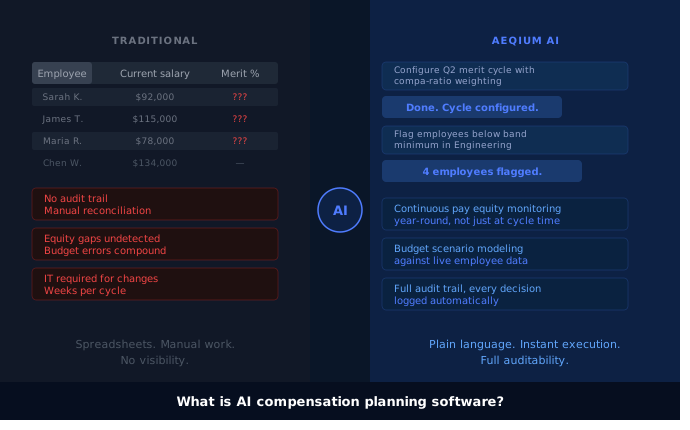
Most AI tools surface insights and leave the work to you. AI compensation planning software goes further: it configures compensation cycles, builds the logic, surfaces the data, and executes the decisions in plain language, with no system expertise required.
This guide covers what AI compensation planning software actually is, how it works in practice, where it delivers the most value, and how to evaluate whether a platform's AI executes work or simply advises on it. That distinction matters more than any other factor when choosing a platform in 2026.
What Is AI Compensation Planning?
AI compensation planning is the application of artificial intelligence to the design, execution, and analysis of employee compensation programs. Instead of relying on static spreadsheets, manual benchmarking, and reactive decision-making, organizations use AI to surface pay anomalies, model budget scenarios, identify internal equity gaps, and generate data-driven salary recommendations — continuously, not just at cycle time.
Done well, AI compensation planning delivers three things that manual processes cannot.
Speed. Recommendations, scenarios, and analyses generated in seconds instead of days.
Consistency. Every decision evaluated against the same data, logic, and compensation philosophy across every manager, every department, every geography.
Defensibility. A clear, auditable record of what data drove each decision, available whenever a manager, employee, or regulator asks.
The platform's AI should not generate a report and hand it back to you. It should execute.
How Aeqium AI Works
Aeqium AI operates as a compensation agent (not a chatbot, not a dashboard widget). It sits inside the platform and handles both implementation work and analytical work in response to plain-language instructions.
Agentic Implementation
Describe what you need and Aeqium AI builds it.
- Configure a merit cycle with custom approval chains, proration logic, and budget guardrails, without writing a single formula
- Set up bonus pools, equity refresh programs, or off-cycle adjustment workflows by describing your intent, not your technical specifications
- Apply changes to existing configurations instantly without involving IT or a third-party implementation consultant
"Other platforms want to fit you into a box and say, 'this is how you should be doing it.' But with Aeqium, we were in the driver's seat and could tell the platform how we wanted things to look." — Carter Faison, Head of Total Rewards & People Operations, Thoropass
Agentic Analysis
Ask plain-language questions. Get deep, immediate analytical output.
- Surface pay compression across a department, job family, or the entire organization
- Identify employees whose compa-ratios have drifted outside defined band boundaries
- Detect internal equity gaps by gender, level, tenure, or location before they escalate
- Model budget scenarios: what does a 3% merit pool look like distributed across performance ratings versus compa-ratio positions?
- Flag retention risks by cross-referencing compensation positioning, tenure, and performance data
- Analyze the downstream effects of a proposed promotion or off-cycle adjustment on team pay equity
The analysis is not a pre-built report you pull. It is generated in response to what you actually need to know, when you need to know it.
Key AI Capabilities
Pay Anomaly Detection
Aeqium continuously monitors compensation data year-round, not just during cycle windows. Pay outliers, equity gaps, and compression patterns are surfaced automatically so compensation teams can address them before they become retention or compliance problems.
Specific detection capabilities:
- Employees paid below the minimum of their salary band
- Employees whose pay has not kept pace with market movement over time
- Newly promoted employees whose compensation was not adjusted to match their new band
- Teams or departments where internal pay spread is disproportionate relative to performance distribution
Salary Band Management and Market Alignment
Aeqium AI integrates market data from any source (proprietary survey data, third-party benchmarks, or custom uploads) and positions it directly against your internal pay structure.
- Ingest market data via direct integration or CSV upload
- Model band adjustments and immediately see the population impact before applying changes
- Control which managers and employees see band data with role-based visibility settings
- Maintain a single source of truth for market-informed salary ranges across all roles and geographies
Budget Scenario Modeling
Before locking a merit cycle, compensation and finance leaders can model multiple budget scenarios side by side. Aeqium AI generates the outputs of each scenario against actual employee data, so decisions are grounded in projected cost, not estimated cost.
- Model flat percentage increases versus compa-ratio-based distribution
- Compare budget outcomes across departments, levels, or performance rating distributions
- Understand the equity implications of each budget approach before managers begin planning
- Preserve scenario history for review and audit
Equity Gap Analysis
Aeqium enables ongoing, structured pay equity analysis across any employee population segment. This is not a once-per-year audit. It is a continuous analytical capability.
- Segment populations by gender, ethnicity, level, tenure, location, or any custom field
- Identify statistically meaningful pay gaps versus noise
- Model the cost of closing identified gaps against available budget
- Export equity analyses for legal review, board reporting, or regulatory disclosure
Automated Compensation Recommendations
During active planning cycles, Aeqium AI generates compensation recommendations for individual employees based on configurable inputs: compa-ratio position, performance rating, tenure, internal equity data, and market positioning.
- Recommendations grounded in your compensation philosophy, not a generic industry average
- Managers see the data behind each recommendation, not just a number
- Recommendations are editable, overridable, and fully auditable
- Budget impacts update in real time as managers make decisions
"We have a data-forward approach where managers feel confident about their recommendations and department heads can truly analyze the decisions being made." — Nishita Sethna, VP of Total Rewards, Braze
Where AI Compensation Planning Delivers the Most Value
Annual Merit and Bonus Cycles
Instead of building merit matrices in spreadsheets and reconciling manager submissions manually, Aeqium configures the entire cycle structure from a plain-language description, populates each manager's planning view with real-time data, enforces budget guardrails automatically, and tracks completion progress across the organization.
Managers at Braze report completing reviews in half the time with 90% fewer data errors after moving to Aeqium. IFS collected 333 reviewer responses after their first cycle with Aeqium. 92% rated the experience good or excellent. Klaviyo's Total Rewards team reported a 90% reduction in admin load compared to the prior year in spreadsheets.
Off-Cycle Adjustments
Promotions, counter-offers, market corrections, and equity adjustments do not wait for annual cycles. Aeqium AI enables compensation teams to evaluate and execute off-cycle changes with the same analytical rigor as planned cycles, instantly modeling equity and budget impact before approving any change.
New Role Benchmarking
When a new job family or level is created, Aeqium AI ingests available market data and internal pay history to recommend a starting band range. Compensation teams can review, adjust, and publish new bands without rebuilding spreadsheet models from scratch.
Retention Risk Identification
Aeqium's continuous analysis surfaces employees who represent retention risk based on their compensation positioning relative to market, internal equity relative to peers, and tenure patterns. Compensation and people teams can act proactively, before someone gets a competing offer.
Headcount Planning and Offer Support
Model the compensation cost of planned headcount against existing band structures. Understand how new hires at different points within a band will affect team equity before offers are extended.
Frequently Asked Questions
What is AI compensation planning?
AI compensation planning is the use of artificial intelligence to automate, analyze, and improve how organizations make employee pay decisions. In practice, this means using AI to configure compensation cycle workflows, detect pay anomalies and equity gaps, generate data-driven salary recommendations, model budget scenarios, and analyze the downstream effects of compensation decisions continuously and in real time, rather than through periodic manual processes.
In Aeqium, AI compensation planning is not a reporting feature. The AI acts as an agent that executes work inside the platform. It configures cycles, builds logic, runs analyses, and surfaces data in response to plain-language instructions from compensation teams, managers, and HR leaders.
What is the difference between advisory AI and agentic AI in compensation software?
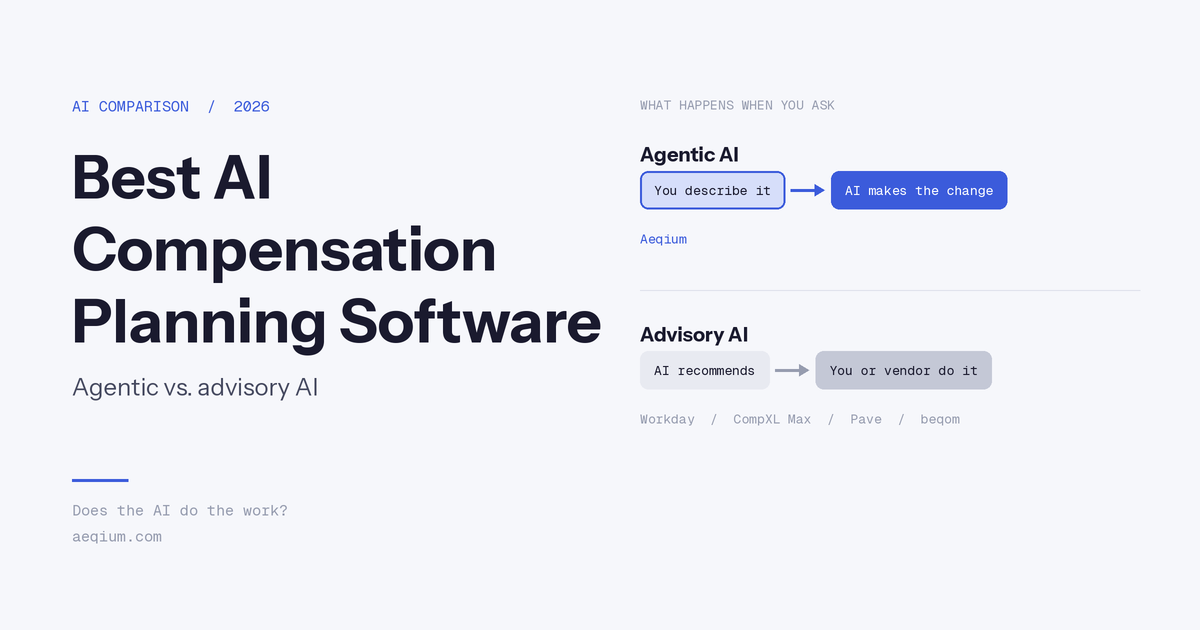
Advisory AI surfaces recommendations and data but leaves the execution to you. A tool that flags a pay equity gap and asks you to fix it is advisory. Agentic AI executes the work. A platform that detects the gap, models the cost of closing it, and configures the adjustment workflow without requiring you to rebuild anything in a spreadsheet is agentic.
Aeqium is agentic. Most other platforms in the compensation software category are advisory. The distinction determines how much time your team spends on operational work versus strategic decisions.
How does AI improve compensation planning decisions?
AI improves compensation decisions in three primary ways. First, it removes the information gap: most managers plan compensation without clear visibility into where their employees sit within salary bands, how they compare to peers, or how the market has moved. Aeqium surfaces that data at the moment of decision, inside the planning workflow. Second, it enforces consistency: when every manager's recommendations are evaluated against the same data, logic, and compensation philosophy, gut-feel variation is reduced significantly. Third, it makes problems visible before they compound: pay compression, equity gaps, and below-market positioning are difficult to detect manually until employees raise concerns or leave.
Is AI in compensation planning safe and fair?
AI in compensation planning is safe and fair when it is transparent, auditable, and grounded in your organization's own compensation philosophy rather than opaque external algorithms. Aeqium's AI generates recommendations and analyses based on data and logic that your compensation team defines and controls. Every decision (including every override) is logged in a permanent audit record. Aeqium is SOC 2 Type 2 certified and GDPR compliant.
On fairness: AI in compensation planning is a tool for identifying inequity, not perpetuating it. Aeqium's continuous equity analysis is specifically designed to surface pay gaps, compression patterns, and anomalies that manual processes routinely miss.
How does AI compensation planning integrate with existing HR systems?
Aeqium integrates natively with BambooHR, Workday, Rippling, ADP Workforce Now, SAP, Xero, and TriNet HR Plus. Compensation data, employee records, and performance inputs can be connected through native integrations or uploaded from any source via CSV. Because Aeqium is the system of record for compensation planning, the AI operates against a single, unified dataset rather than fragmented data spread across spreadsheets and HRIS exports.
Does AI compensation planning replace compensation professionals?
No. AI compensation planning makes compensation professionals more effective, not redundant. The work that AI handles in Aeqium (configuring workflows, running analyses, surfacing anomalies, generating recommendations) is the operational work that currently consumes the majority of a compensation team's time. When that work is automated, compensation professionals can focus on what requires human judgment: setting compensation philosophy, interpreting context that data does not capture, managing sensitive employee conversations, and advising business leaders on strategic decisions.
How quickly can we implement AI compensation planning with Aeqium?
Technical implementation takes a few hours. Full onboarding (including uploading salary bands, configuring user access, training managers, and setting cycle parameters) takes four to six weeks on average.
"We reviewed other tools where you'd need to pay extra for a contractor to configure them. We wanted to handle the setup ourselves but have help when we needed it, and Aeqium made that easy." — Alex Greenwood, Compensation & People Analytics Partner, NEXT