Best Market Pricing Software for Compensation Planning (2026)

Last updated: October 2026.
Market pricing is the process of building and updating your pay ranges. Market data is one input, but most of the work happens after the data arrives: matching jobs to survey codes, applying your comp philosophy, and calibrating messy data into ranges you can actually use and get approved. The best market pricing software depends on whether you need the data itself, the process automated, or both.
What market pricing involves
- Job architecture and job matching: Map each of your jobs to the matching job codes in each survey you license.
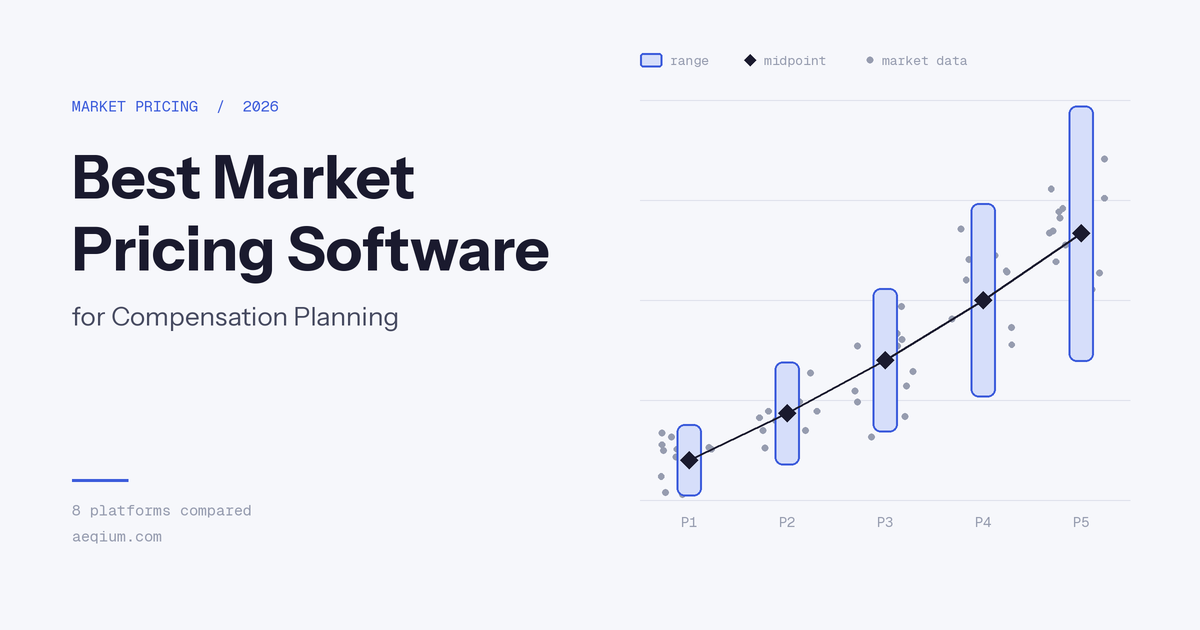
- Apply your comp philosophy: Turn market data into draft ranges, for example a midpoint at the 65th percentile with a 20% spread.
- Calibrate and refine: Fix what the formula gets wrong. Survey data is noisy, so draft ranges can jump 50% year over year, invert between levels, or put half your team below range.
- Approve and publish: Show executives the cost and impact, then publish the final ranges.
Comp teams report that calibration alone can take several weeks of line-by-line spreadsheet work. That's the step most tools leave to you.
Two kinds of market pricing software
- Data-plus-software vendors: Payscale, Salary.com, Pave, and Ravio sell their own market data along with tools to use it.
- Survey providers: Mercer and Aon (Radford) are the surveys many enterprises license.
- Survey-neutral software: Aeqium automates the market pricing process using whichever surveys you already license.
Quick answer
- Best for automating market pricing with the surveys you already license: Aeqium
- Best for market data and planning from one vendor: Payscale
- Best for broad US salary data with built-in tools: Salary.com
- Best for benchmarking-led US tech companies: Pave
- Best for global survey data: Mercer
- Best for tech, life sciences, and financial services survey data: Aon (Radford and McLagan)
- Best for European tech companies: Ravio
- Best for survey management and benchmarking: BetterComp
Comparison table
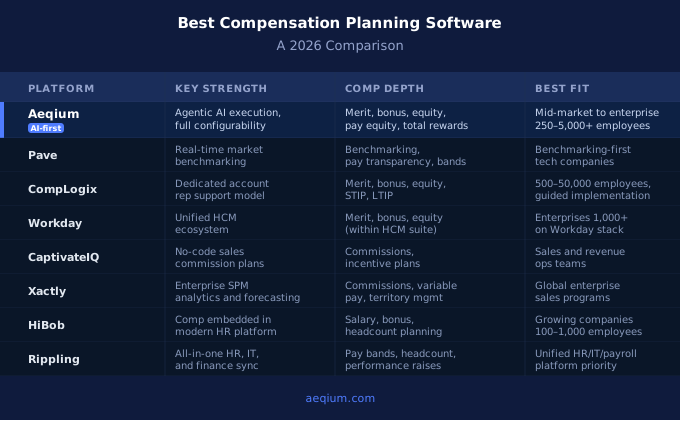
| Platform | Type | Data source | Strongest at | Best fit |
|---|---|---|---|---|
| Aeqium | Survey-neutral market pricing software | Your licensed surveys, any provider | Band generation, calibration, and approval, connected to comp cycles | Enterprises that license one or more surveys |
| Payscale | Data plus software | Payscale's own data sources | Market data with planning tools | Teams that want data and planning from one vendor |
| Salary.com | Data plus software | Salary.com's own data | Broad US salary data with job pricing tools | Teams that want a single data-and-tools vendor |
| Pave | Data plus software | Pooled data from live HRIS integrations | Current benchmarks for tech roles | US-based mid-market tech companies |
| Mercer | Survey provider | Mercer surveys | Global survey coverage | Global enterprises buying survey data |
| Aon (Radford, McLagan) | Survey provider | Radford and McLagan surveys | Tech, life sciences, and financial services data | Companies benchmarking against those industries |
| Ravio | Data plus software | Data from live HRIS integrations | European tech benchmarks | European tech companies |
| BetterComp | Benchmarking platform | Survey and market data | Survey management and benchmarking | Teams managing survey participation |
Platform profiles
1. Aeqium: Best for automating market pricing with the surveys you already license
Aeqium is market pricing software, not a data vendor. It automates building and updating pay ranges using whichever surveys you license, so you keep your survey choices and the job matching you've already invested in.
- Any survey, any number of surveys: Radford, Mercer, WTW, or any other provider. The Aeqium team imports your data for you.
- Job architecture and matches in one place: Store your job families, levels, and the survey job codes each one maps to.
- Band generation from your comp philosophy: Set target percentiles and spreads by level and generate first-draft ranges from your market data.
- Rules instead of line-by-line fixes: Set policies like capping year-over-year band increases at 5%, and apply them across every range.
- Overrides that carry forward: Adjust individual bands with percentage multipliers you can reuse in future refreshes.
- Impact analysis: See bands that changed too much, midpoint progression between levels, employees below or above range, the cost to move people into range, and compa-ratio by job.
- Ask AI: Ask questions in plain English, such as the cost of moving all engineers to the new midpoint, and get answers from your live data.
- Draft band sets: Work on a refresh privately and publish only when it's approved, without affecting what managers and employees see.
- Visuals for approval: Band changes, midpoint progression, and employee placement charts ready to share with executives.
- Connected to comp cycles: Updated ranges flow straight into your next merit cycle.
- Access controls and pay transparency: Role-based band visibility by job family, plus employee-facing ranges on MyComp.
- Security: SOC 2 Type 2. AI runs inside Aeqium's own AWS environment, and customer data is never used to train models.
Consider: Aeqium doesn't sell market data, so you license surveys separately. See where Aeqium's market data comes from.
2. Payscale: Best for market data and planning from one vendor
Payscale offers compensation data alongside market pricing and pay structure tools, and its tools are built around Payscale's own data sources.
Consider: If you already license surveys from other providers, confirm how that data fits into Payscale's workflow.
3. Salary.com: Best for broad US salary data with built-in tools
Salary.com's CompAnalyst combines Salary.com's market data with job pricing and pay structure tools built around that data.
Consider: It's strongest when Salary.com is your primary data source. Teams using other surveys should confirm how they're supported.
4. Pave: Best for benchmarking-led US tech companies
Pave pools market data from more than 9,000 companies through live HRIS integrations, with its strongest coverage among US-based mid-market tech companies. It also offers salary bands and range tools.
Consider: Validate data coverage for non-tech roles and non-US markets, and ask how program configuration changes are made.
5. Mercer: Best for global survey data
Mercer is one of the largest compensation survey providers, with coverage across countries and industries.
Consider: Mercer's core strength is survey data. Teams still need a process, in spreadsheets or software, to turn that data into calibrated ranges.
6. Aon (Radford and McLagan): Best for tech, life sciences, and financial services data
Aon's Radford surveys are widely used in technology and life sciences, and McLagan in financial services. Their job leveling conventions (such as P and M levels) are common in those industries.
Consider: Like Mercer, Aon provides the data. Calibration and range updates happen in your own spreadsheets or a separate platform.
7. Ravio: Best for European tech companies
Ravio provides compensation benchmarks drawn from live HRIS integrations, with a focus on European tech companies.
Consider: Validate coverage outside Europe and outside tech roles.
8. BetterComp: Best for survey management and benchmarking
BetterComp provides compensation benchmarking and helps teams manage salary survey participation.
Consider: Evaluate how far it goes beyond benchmarking into band generation, calibration, and approval.
How to choose
- If you already license surveys: Choose survey-neutral software so you keep your data and your job matches. Aeqium is built for this.
- If you don't have market data yet: Start with a data vendor (Payscale, Salary.com, Pave, Ravio) or a survey provider (Mercer, Aon).
- If calibration is where your time goes: Prioritize impact analysis, rules, and AI question answering over the size of the dataset.
- If ranges feed your merit cycle: Choose a platform where updated ranges flow directly into the cycle.
For broader comparisons, see our 10 best compensation planning software platforms and our enterprise comparison.
Frequently asked questions
What is market pricing?
Market pricing is the process of building and updating pay ranges. It combines market data with your job architecture, applies your comp philosophy (such as a target percentile and spread), then calibrates the results into ranges you can approve and use.
What's the difference between market pricing and benchmarking?
Benchmarking is comparing your pay to market data. Market pricing is the full process of turning that data into pay ranges, including job matching, applying your comp philosophy, calibrating, and getting approval.
Do I need more than one salary survey?
Many enterprises license more than one survey to get better coverage by region or role. Survey-neutral software like Aeqium works with any number of surveys.
Can I use my existing survey data with Aeqium?
Yes. Aeqium works with any survey provider, and the Aeqium team imports your licensed data. See where Aeqium's market data comes from.
How long does a range refresh take?
Teams working in spreadsheets often spend several weeks on calibration alone. Software with band generation, rules, and impact analysis cuts that down by automating line-by-line checks.
How often should pay ranges be updated?
Most companies run a full range refresh once a year, often timed before the annual comp cycle so new ranges can inform market adjustments.