Best Compensation Management Software and Tools (2026)

Last updated: October 2026.
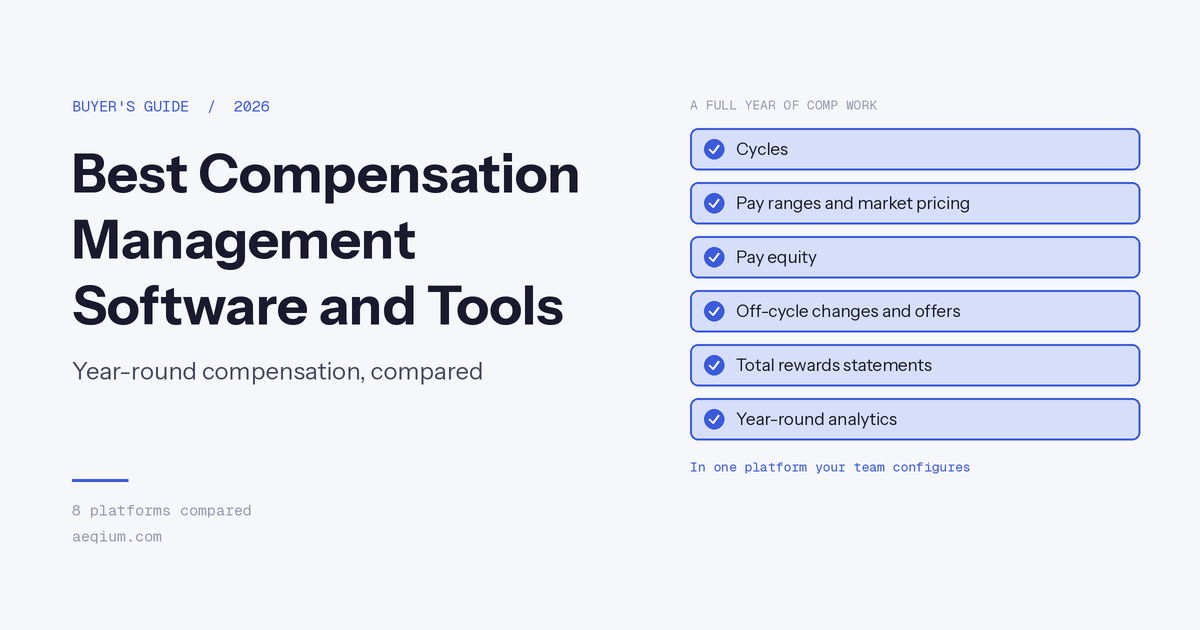
Compensation management software runs pay year-round, not just during the annual cycle. It covers merit and bonus cycles, pay ranges and market pricing, pay equity, off-cycle adjustments, offers, and how employees see their total rewards. The best compensation management tool is the one that handles all of it in one place, and lets your team change it as the business changes. This guide compares 8 platforms on the full year of compensation work.
Compensation management vs. compensation planning software
- Compensation planning software focuses on the cycle: merit, bonus, and promotion planning, budgets, and approvals.
- Compensation management software covers the full year: cycles, plus pay ranges, market pricing, pay equity, off-cycle changes, offers, total rewards communication, and ongoing analytics.
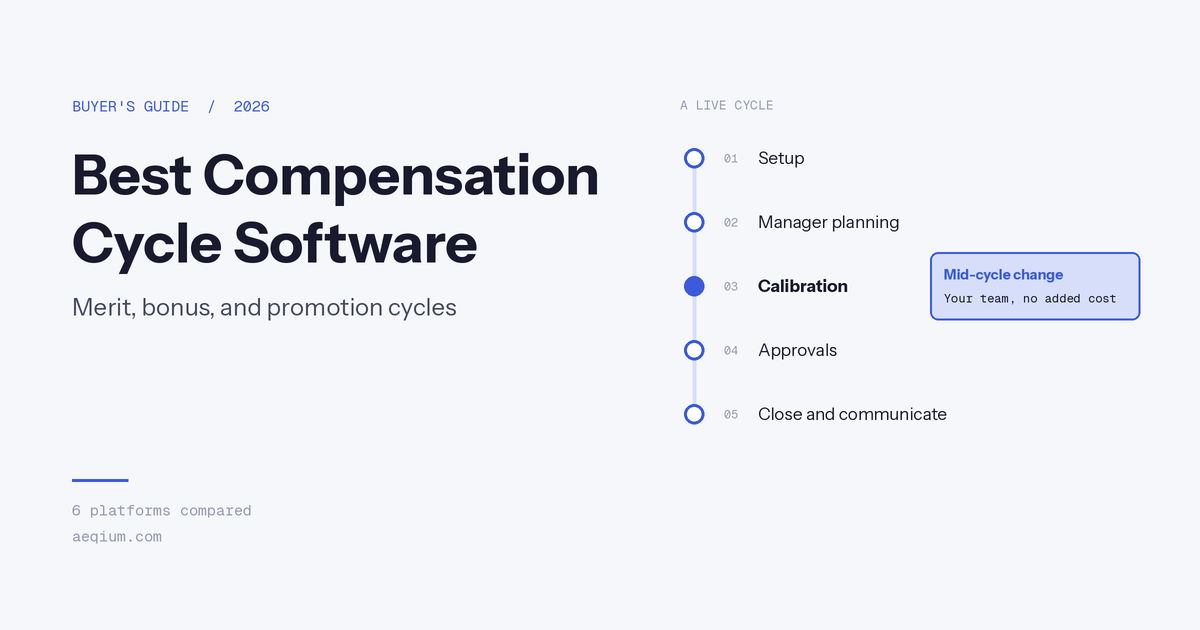
For cycle-focused tools, see our best compensation planning software platforms compared and best compensation cycle software.
What compensation management tools should cover
- Cycles: Merit, bonus, equity, LTI, promotion, and performance incentive programs.
- Pay ranges and market pricing: Building and updating ranges from the survey data you license.
- Pay equity: Ongoing analysis, not a once-a-year audit.
- Off-cycle changes and offers: Promotions, adjustments, and offer letters between cycles.
- Total rewards communication: Statements and employee access to their own compensation.
- Year-round analytics: Answers to ad hoc questions from leaders, without spreadsheet exports.
- Change ownership: Who changes rules, ranges, and workflows, and whether it's billed.
Quick answer
- Best for complex, global enterprise compensation management your team owns: Aeqium
- Best for enterprises fully standardized on Workday: Workday Compensation
- Best for enterprises fully standardized on SAP: SAP SuccessFactors Compensation
- Best for vendor-configured programs with commission payouts: beqom
- Best for vendor-configured compensation programs: HRSoft
- Best for spreadsheet-style planning with Salary.com data: CompXL
- Best for US tech benchmarking data: Pave
- Best for market data and planning from one vendor: Payscale
Comparison table
| Platform | Type | Year-round strengths | Changes made by | Best fit |
|---|---|---|---|---|
| Aeqium | Compensation management platform | Cycles, market pricing, pay equity, offers, total rewards, and AI analytics in one platform | Your team, with AI that executes changes, at no added cost | Enterprise total rewards teams running complex or global programs |
| Workday Compensation | HCM suite module | Compensation inside the Workday data model | Specialists or partners, often billed | Enterprises fully on Workday |
| SAP SuccessFactors Compensation | HCM suite module | Compensation inside the SAP data model | Specialists or partners, often billed | Enterprises fully on SAP |
| beqom | Enterprise total compensation | Total compensation with commission payouts | Vendor or implementation partners, often billed | Enterprises that want payouts and total rewards in one system of record |
| HRSoft | Compensation management platform | Vendor-configured merit, bonus, and statements | Vendor-led, often billed | Teams that want the vendor to own setup |
| CompXL | Spreadsheet-style planning with bundled data | Excel-compatible workbook with Salary.com data | Salary.com's team makes changes for you | Teams standardizing on Salary.com data |
| Pave | Benchmarking and comp platform | Market data from live HRIS integrations | Vendor-led | US-based mid-market tech companies |
| Payscale | Market data and comp software | Compensation data sources plus planning tools | Not a focus of this comparison | Teams that want data and planning from one vendor |
The best compensation management tools
1. Aeqium: Best for complex, global enterprise compensation management your team owns
Aeqium manages compensation year-round for enterprise total rewards teams, across business units, countries, and currencies. Customers include Amazon, PwC, IFS, Klaviyo, Redis, V2X, Braze, and Hopper.
- Cycles: Merit, bonus, equity, LTI, promotion, off-cycle, and performance incentive programs, including sales commission planning and calculation.
- Market pricing: Build and update pay ranges from any survey you license, generate draft ranges from your comp philosophy, set rules such as capping year-over-year increases, and see the impact before you publish.
- Pay equity: Out-of-the-box reports, ad hoc analysis covering gender, race, and ethnicity, and year-round monitoring of outliers, equity gaps, and compression.
- Offers and off-cycle changes: Offer letters and off-cycle adjustments in the same system as your cycles.
- Total rewards communication: Total compensation statements in multiple languages, plus MyComp for employee access.
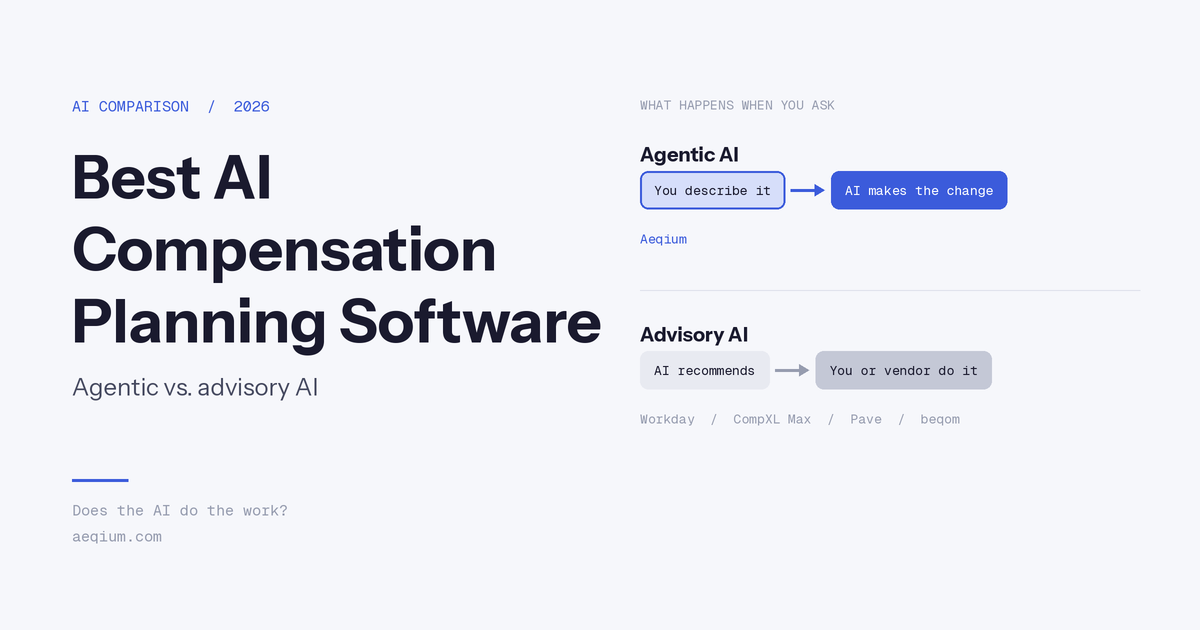
- AI that does the work: Assist executes configuration changes you describe in plain English, and Analyst answers questions against live data.
- No cost to change: No change fees, services hours, or service contracts.
- Integrations: 200+ HR platforms and tools, including ADP, Workday, UKG, Paylocity, BambooHR, and Rippling.
- Security: SOC 2 Type 2 certified and GDPR compliant. AI runs inside Aeqium's own AWS environment, and customer data is never used to train models.
- Fast onboarding: Averages four to six weeks, with no implementation fee and support included.
Results
- Braze and Hopper report 90% fewer errors in compensation data.
- IFS cut its global cycle to about a month, roughly half its previous length.
- Klaviyo's admin load in its first Aeqium merit cycle was a tenth of the prior spreadsheet-based year.
Consider: Aeqium works with the survey data you license rather than selling its own dataset. Commission payouts stay in your payroll or commission system of record.
2. Workday Compensation: Best for enterprises fully on Workday
Workday Compensation manages pay inside Workday HCM, sharing one data model with payroll, talent, and finance.
Consider: Changes beyond standard configuration often require Workday specialists or partners. Many enterprises keep Workday as the system of record and manage complex programs in a dedicated platform. See Workday Advanced Compensation vs Aeqium.
3. SAP SuccessFactors Compensation: Best for enterprises fully on SAP
SAP SuccessFactors Compensation covers salary, bonus, and variable pay within the SuccessFactors suite.
Consider: Its value is highest when your organization is committed to the full SAP stack. Configuration changes typically go through SAP specialists or partners.
4. beqom: Best for vendor-configured programs with commission payouts
beqom is an enterprise total compensation platform covering salary, bonus, long-term incentives, and commission payouts in one system of record.
Consider: Configuration is vendor- or partner-led and often billed. See Aeqium vs beqom and beqom alternatives.
5. HRSoft: Best for vendor-configured compensation programs
HRSoft configures and customizes merit, bonus, and statement programs for each client, with performance management in the platform.
Consider: Changes are vendor-led and often billed. See Aeqium vs HRSoft.
6. CompXL: Best for spreadsheet-style planning with Salary.com data
CompXL is Salary.com's compensation planning product, an Excel-compatible workbook with Salary.com market data bundled in.
Consider: Salary.com's team makes configuration changes for you, and planning still runs like a spreadsheet. See Aeqium vs CompXL.
7. Pave: Best for US tech benchmarking data
Pave pools market data from more than 9,000 companies through live HRIS integrations, with its strongest coverage among US-based mid-market tech companies.
Consider: Program configuration is typically handled with Pave's team. Global enterprises should validate data coverage for non-tech roles and non-US markets.
8. Payscale: Best for market data and planning from one vendor
Payscale combines compensation data sources with planning and pay structure tools.
Consider: The platform is centered on data. Evaluate cycle workflow depth and year-round analytics against your program.
How to choose compensation management software
- Map your full year: List every compensation process you run, including cycles, range refreshes, off-cycle changes, offers, and reporting. Then check which tool covers all of them.
- Ask who makes changes: Rules, ranges, and workflows change every year. Find out whether your team, the vendor, or IT makes those changes, and whether they're billed.
- Check your market data: Decide whether you want a vendor's dataset, or software that works with the surveys you already license.
- Test with your real programs: Have each vendor configure your actual merit matrix and a range refresh in the demo.
For enterprise-specific needs, see our enterprise compensation planning software comparison and 6 Criteria for Enterprise Compensation Platforms.
Frequently asked questions
What is compensation management software?
Compensation management software runs employee pay year-round: merit and bonus cycles, pay ranges and market pricing, pay equity, off-cycle changes, offers, and total rewards communication. See what compensation management software is.
What are the best compensation management tools?
For complex, global enterprise compensation, Aeqium, because it manages cycles, market pricing, pay equity, and total rewards in one platform your team configures itself. Workday and SAP suit enterprises standardized on those suites. beqom and HRSoft suit teams that want vendor-configured programs.
What's the difference between compensation management and compensation planning software?
Planning software focuses on the cycle itself. Management software covers the full year, including pay ranges, market pricing, pay equity, off-cycle changes, offers, and total rewards communication.
Does compensation management software include market data?
Some vendors sell their own data, such as Pave, Payscale, and Salary.com. Aeqium works with any survey you license.
How much does compensation management software cost?
Most vendors quote custom pricing based on employee count. Compare total cost, including implementation, support, and changes after go-live. Aeqium has no implementation fee, includes support, and has no change fees.