GDPR-Compliant Compensation Software: How to Evaluate Vendors (2026)

Last updated: October 2026. This guide is for general information and isn't legal advice.
Compensation software processes some of the most sensitive employee data a company holds: salaries, bonuses, equity, performance ratings, and often demographic data for pay equity analysis. Under GDPR, your company is the data controller, and the compensation vendor is a processor acting on your instructions. There's no single GDPR certification that proves a vendor is compliant, so evaluating one comes down to the contract, the data flows, and the controls. This checklist covers what to ask.
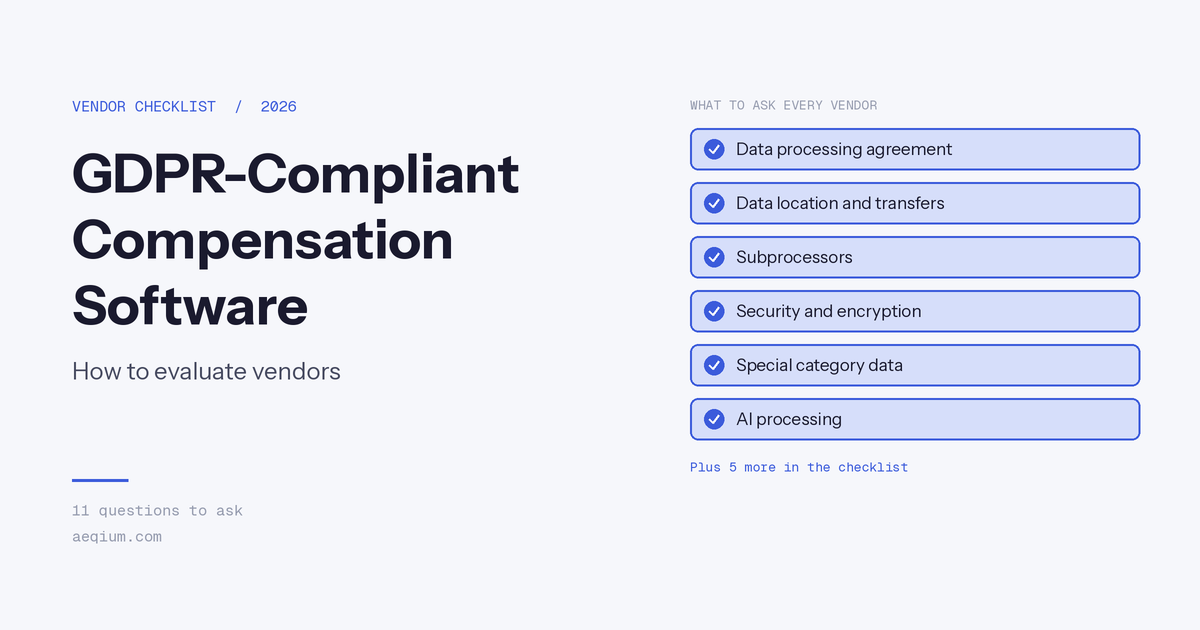
The GDPR checklist for compensation software
1. Data processing agreement (DPA)
GDPR requires a written agreement with every processor. Ask for the vendor's DPA early, and check that it covers processing instructions, confidentiality, security measures, subprocessors, assistance with your obligations, and deletion at the end of the contract.
2. Data location and international transfers
Ask where customer data is hosted. If EU or UK employee data leaves the EU or UK, the vendor needs a lawful transfer mechanism, such as Standard Contractual Clauses (SCCs), the UK Addendum, or certification under the EU-US Data Privacy Framework. Your privacy team may also want a transfer impact assessment.
3. Subprocessors
Ask for the full subprocessor list, what each one does, and how you're notified of changes. You should be able to object to a new subprocessor.
4. Security controls
Look for independent audits such as SOC 2 Type 2, encryption at rest and in transit, role-based access, and audit trails of every change.
5. Breach notification
GDPR requires processors to notify controllers of a personal data breach without undue delay. Check the DPA for a clear notification commitment and timeline.
6. Special category data
Pay equity analysis often uses race or ethnicity data, which GDPR treats as special category data with stricter rules. Confirm the DPA lists every data category the platform will process, and that access to that data is restricted.
7. Data minimization and access
Managers should only see the employees and data they need. Ask how visibility is controlled by role, team, and region.
8. Employee rights
Employees can request access to, correction of, or deletion of their data. Ask how the vendor helps you respond.
9. Retention and deletion
Ask how long data is kept after the contract ends, and how deletion or return works.
10. AI processing
Ask where AI processing happens, whether your data trains any models, and whether AI makes decisions about individual employees. GDPR restricts decisions based solely on automated processing that significantly affect people, so pay decisions should stay with humans.
11. Audits and impact assessments
Ask whether you can audit the vendor, and whether they support your data protection impact assessment (DPIA), which compensation processing often requires.
How Aeqium answers the checklist
| Question | Aeqium |
|---|---|
| DPA | Standard DPA available to every customer |
| Data location | Hosted in the US on AWS |
| Transfer mechanism | 2021 SCCs (Module 2) for EU transfers, the UK Addendum for UK transfers, and SCCs adapted for Swiss transfers |
| Subprocessors | Full list available on request, with advance notice of changes and a 10-day objection window |
| Security | SOC 2 Type 2, audited annually; AES-256 encryption at rest and TLS in transit; role-based access and a full audit trail |
| Employee rights | Aeqium helps customers respond to data subject requests |
| Retention and deletion | Customer data is deleted or returned within 90 days of contract end |
| AI processing | AI runs inside Aeqium's own AWS environment, customer data is never used to train models, and pay decisions stay with managers and approvers |
| Audits and DPIAs | Annual audit right with 30 days' notice, plus support for DPIAs |
| Government access | Aeqium notifies customers of government requests for their data |
GDPR and the EU Pay Transparency Directive
The two overlap. The directive gives employees the right to request pay information about colleagues doing the same work, while GDPR limits what you can disclose about individuals. Compensation software needs to support both: accurate pay data by job category for reporting and requests, and access controls that protect individual records.
For more on how Aeqium's AI works, see agentic AI vs. advisory AI in compensation software. To compare platforms, see the best compensation management software and tools.
Frequently asked questions
Is there a GDPR certification for compensation software?
No single certification proves GDPR compliance. Evaluate vendors on their DPA, transfer mechanisms, subprocessors, security audits like SOC 2 Type 2, and how they support your obligations as controller.
Can compensation data be stored in the US under GDPR?
Yes, with a lawful transfer mechanism such as Standard Contractual Clauses or Data Privacy Framework certification. Aeqium hosts data in the US and covers EU, UK, and Swiss transfers with SCCs in its DPA.
Is pay equity data special category data under GDPR?
Race and ethnicity data used in pay equity analysis is special category data, which requires stricter safeguards. Confirm your vendor's DPA covers it and that access is restricted.
Can AI make compensation decisions under GDPR?
GDPR restricts decisions based solely on automated processing that significantly affect individuals. Use AI to configure and analyze, and keep pay decisions with managers and approvers.
What should a compensation software DPA include?
Processing instructions, confidentiality, security measures, subprocessor terms, breach notification, assistance with data subject requests and DPIAs, audit rights, and deletion at the end of the contract.